Showing posts with label Beginners. Show all posts

Friday, 15 April 2011

Indefinite Nouns — The Indefinite Article

The Indefinite Article in Arabic

In Arabic a noun is indefinite by the mere absence of the definite article; there is no indefinite article in Arabic like there is in English. So, there is no equivalent for "a". To translate "a boy" for example, we would use only the Arabic equivalent of "boy", leaving out the "a", for which there is no equivalent.
The following are examples of indefinite nouns: 
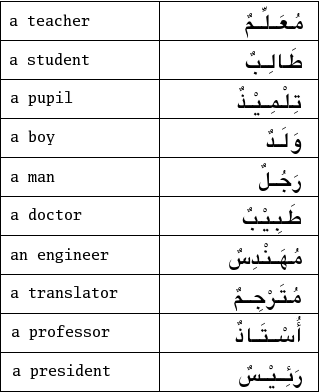

Each of the above nouns ends with double vowels (called tanween).
NOTE
The double vowel can be considered as the "indefinite article" of the Arabic language; similarly to the English "a" it is a vowel, but on the contrary, it comes at the end of a word.

Arabic sentences — The Nominal Sentence


Types of Arabic sentences

Arabic sentences are of two types: nominal and verbal. In this lesson we shall learn how to form the Arabic nominal sentence. We'll leave the verbal sentence for later in the course.
You are expected to have knowledge of indefinite and definite nouns. We will use both types of nouns to make nominal sentences.

The simple Nominal Sentence : Noun + Noun

In this lesson, you will learn how to form a simple Arabic sentence using only nouns.
By definition, a nominal sentence is a sentence which starts with a noun. The nominal sentence starts with a definite noun. This first noun is then followed by another noun which is indefinite.


You will have noticed that each of the Arabic sentences above starts with a definite noun followed by an indefinite one. The translation reflects this by the use of "the" and "a" for each noun respectively.
However, there is no mention of the English "is" in the Arabic sentences, whereas the nouns were translated exactly. This brings us to the main difference between English and Arabic sentences: a complete English sentence must contain a verb, whereas a complete Arabic sentence needs not (in fact there is a verb, but it does not show when in the present tense; we'll keep the details for later).

Summary
  • We can form an Arabic sentence using a definite noun followed by an indefinite one.
  • The verb "to be", when in the present tense, is not translated into arabic.